
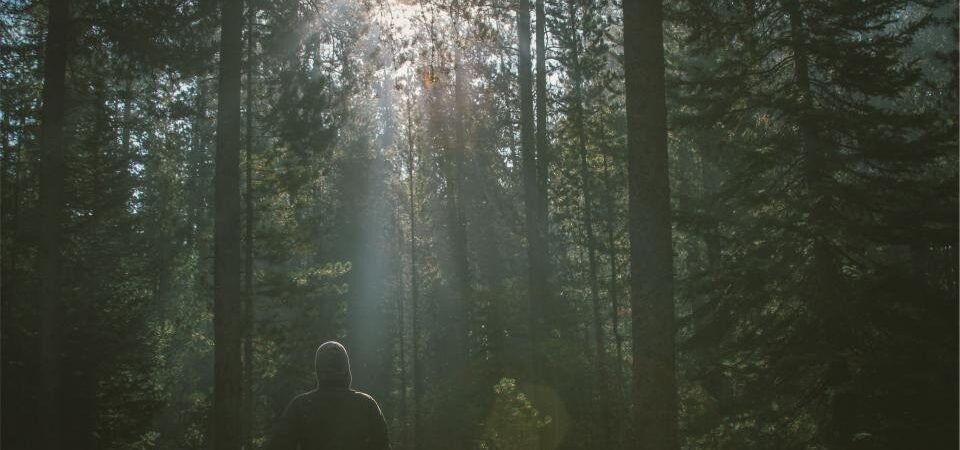
There is a particular kind of light you only find in a forest. It falls in shafts between the branches, flickers on the ground as the leaves move, and turns ordinary air into something golden. Most of us have felt our shoulders drop and our breathing slow in a place like that. But is there more to it than a pleasant feeling?
Researchers have been asking that question for decades. The answers are not magic, but they are fascinating.
The Practice of Forest Bathing
In the 1980s, Japan introduced a practice called shinrin-yoku, usually translated as “forest bathing.” It does not involve water. It simply means spending unhurried time among trees, paying attention with all your senses.
Since then, studies in Japan, Korea, and elsewhere have compared time spent in forests with time spent in city environments. Many of these studies report that forest time is associated with lower stress markers, a calmer heart rate, and improved mood. Researchers are careful to say that study sizes are often small and that more work is needed, but the overall direction of the findings is consistent: nature tends to help us settle.
Light and Your Body Clock
Sunlight does more than help us see. Your body runs on a roughly 24-hour internal clock, known as the circadian rhythm, and light is its most important signal.
Morning daylight tells your brain that the day has started. It helps set the timing for alertness during the day and sleepiness at night. Modern life often works against this rhythm: we spend our days under dim indoor lighting and our evenings in front of bright screens.
A forest walk in the morning offers a gentle correction. You receive natural daylight, softened by the canopy, while your body moves at an easy pace.
The Many “Frequencies” of a Forest
People often describe forests as having a calming frequency. In scientific terms, there are several real things this can mean.
The Frequencies of Light
Sunlight is a mix of many wavelengths, from violet to red. Leaves absorb much of the red and blue light for photosynthesis and reflect green, which is why forest light has its distinctive color. Some researchers in environmental psychology suggest that green, natural scenes require less mental effort to process, giving the attention system a chance to rest. This idea is known as Attention Restoration Theory.
The Frequencies of Sound
Forests are rarely silent. Wind in the leaves, flowing water, and birdsong create a layered, irregular soundscape. Studies of natural sounds suggest they are generally perceived as more relaxing than traffic or mechanical noise, which can keep the nervous system on alert.
The Rhythm of Flicker
The gentle, irregular movement of light through leaves is very different from the steady glare of a screen. Many people find that this soft, shifting pattern draws attention outward and quiets busy thoughts.
How to Try It Yourself
You do not need a remote mountain forest. A park with mature trees can be enough.
- Go early. Morning light supports your body clock and the air is often cooler and quieter.
- Leave the phone in your pocket. The point is attention, not photos.
- Walk slowly. Aim for a pace where you can notice details: bark texture, the smell of soil, the sound overhead.
- Pause in a patch of light. Stand still for a minute and let your eyes relax on the movement of the leaves.
- Stay a while. Even 20 minutes can feel noticeably different. Longer is a gift.
- Protect your skin and eyes. Never look directly at the sun, and use sun protection when you are in open light for long periods.
The Takeaway
Sunlight in the forest is not a cure for anything, and it is wise to be skeptical of anyone who promises that. What the research does suggest is that time among trees, in natural light, tends to calm the body and refresh the mind. In a world that rarely slows down, that is no small thing.
The forest does not hurry, and yet everything in it gets done. Perhaps that is the lesson it has been offering us all along.
This article is for general information and is not medical advice.